


Last Updated: 17th July 2026
Written by Shaun, Managing Director and co-founder of Departure Pets – with lifelong experience in animal care and formal qualifications in animal handling and behaviour.
If your flat-faced dog or cat is booked to fly, one document will matter more than any other on the day: the BOAS assessment. Here is what it actually is, when you need one, and why it isn’t quite as simple as “get a vet check.”
Key Takeaways
- A BOAS assessment is a specific vet examination of a pet’s airway and fitness to fly, not a routine health check.
- For brachycephalic breeds, the assessment needs to be completed within 60 days of travel (current at the time of publication) and presented to the airline as a physical copy at lodgement.
- Where the assessment is carried out matters. Qantas and Virgin Australia don’t treat overseas issued certificates the same way.
- If your pet is arriving into Australia and needs an onward domestic flight, this can affect which airline is available to you, so it’s worth checking with your consultant before the assessment is booked.
- A BOAS assessment doesn’t guarantee serviceability or a travel date. Your Departure Pets consultant will confirm what’s needed for your pet’s breed and route.
What is BOAS?
Brachycephalic Obstructive Airway Syndrome, or BOAS, is a condition affecting flat-faced dogs and cats, caused by the compressed airway anatomy behind their distinctive look. It can affect how comfortably a pet breathes, especially when they’re warm, stressed, or in an unfamiliar environment, which is exactly the combination air travel involves. For a deeper look at the condition itself, the RSPCA Knowledgebase has a thorough explanation of what BOAS is and how it’s recognised.
This is why brachycephalic breeds are treated as a specialist category for pet transport, rather than being assessed under the standard travel rules that apply to longer nosed breeds. You can see how this plays out across the full journey on our page on pet transport for brachycephalic dogs and cats.
What is a BOAS assessment?
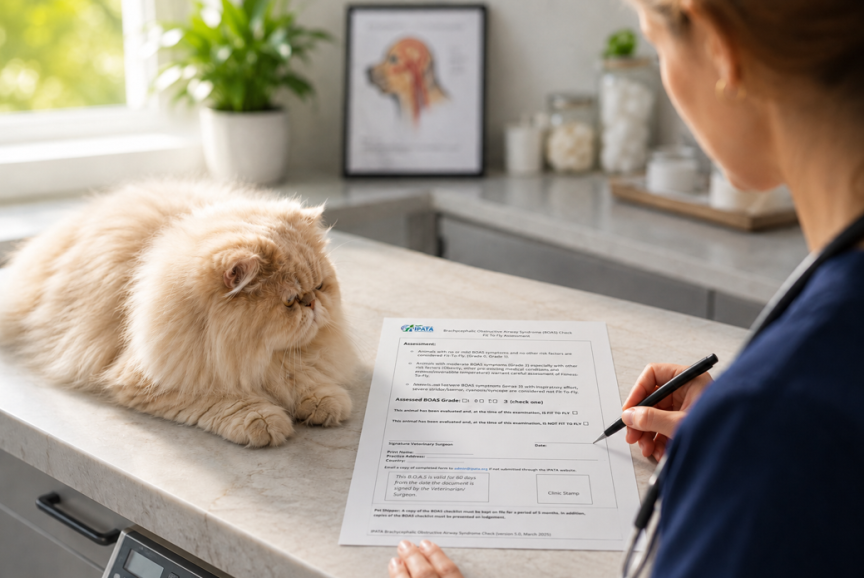
A BOAS assessment is a clinical examination carried out by a registered veterinarian to check your pet’s airways and overall fitness for air travel. It isn’t the same as an annual check-up or a general wellness exam. The vet is specifically assessing whether your pet’s airway function is likely to cope with the demands of a flight, including the change in environment and the time spent in a pet travel crate.
The outcome of the assessment is a certificate. This needs to be presented to airline staff as a physical copy at the time your pet is checked-in for travel, so it’s worth keeping the original safe and easy to access on travel day rather than relying on a photo or scan.
When do I need a BOAS assessment for pet travel?
For brachycephalic breeds, the assessment needs to be completed within 60 days of travel (current at the time of publication). Airline and regulatory timeframes can be updated, so this window should always be confirmed with your Departure Pets consultant when you’re organising your pet’s travel dates, rather than assumed from a previous booking.
Because the assessment has a shelf life, timing it too early can mean it expires before your pet flies, while leaving it too late can create a scramble to get an appointment. Your consultant can help you plan the assessment date around your confirmed travel window.
What happens during a BOAS assessment?
Your vet will examine your pet’s airway, breathing and general condition, and assess how they’re likely to manage the stress of travel. If any concerns are identified, your vet may recommend further investigation before signing off on fitness to fly. The assessment results in written documentation confirming your pet is fit for air travel, which your consultant will ask you to provide ahead of your travel date.
What if my pet doesn’t pass the BOAS assessment?
If a vet determines your pet isn’t fit to fly at the time of the assessment, they won’t be cleared for travel, and a re-booking or cancellation fee may apply. This outcome sits with the examining vet rather than with Departure Pets, so we’d always recommend booking the assessment with enough time to work through any follow-up if it’s needed. Your consultant can talk you through timing this alongside your broader travel plans.
Does it matter where my pet’s BOAS assessment is completed?
Yes, and this is one of the most commonly missed details. If your pet is completing quarantine in Australia before an onward domestic flight, whether the airline will accept the BOAS certificate depends on where the assessment was carried out.
Australia’s biosecurity import requirements for cats and dogs are set out by DAFF (Department of Agriculture, Fisheries and Forestry), and you can read more on their bringing cats and dogs to Australia page. Import requirements are separate from the airline’s own documentation rules for the domestic leg of the journey, which is where the BOAS certificate comes in. The BOAS assessment is a mandatory requirement imposed by the two Australian airlines that transport brachy pets (Virgin Australia and Qantas) and cannot be waived or overridden.
Even if your brachycephalic pet was not required to obtain a BOAS assessment for its international flight, or was able to travel to Australia without one (as not all international airlines require a BOAS assessment), Australian domestic airlines still mandate this assessment before they will accept a brachycephalic pet for travel.
(With the exception of brachy cross breeds on Qantas, as these pets are exempt from a BOAS).
Which airlines accept overseas issued BOAS certificates?
If your pet’s BOAS certificate was completed by an overseas veterinarian who isn’t registered in Australia, Qantas is currently the only domestic airline that will accept this documentation for onward travel.
Virgin Australia will only accept BOAS certificates that have been completed and signed by an Australian registered veterinarian.
If your pet is travelling internationally into Australia and will need a BOAS assessment for an onward domestic flight, it’s worth talking this through with your Departure Pets consultant before the assessment is arranged. This helps make sure the certificate will be accepted by the airline you need, and can help avoid delays or an additional vet appointment once your pet is released from quarantine.
Planning brachycephalic pet travel
A BOAS assessment is just one part of arranging safe travel for a flat-faced pet. Our brachycephalic pet transport page covers the full picture, including crate requirements, age minimums and airline routes. If you’re also weighing up travel timing around the weather, our article on how cold weather affects pet air travel in Australia is a useful companion read.
When you’re ready, request a domestic pet transport quote and we’ll match you with the right specialist team to organise your brachycephalic pet’s journey.
BOAS Assessment FAQs
- How long is a BOAS certificate valid for?
Current guidance is that the assessment needs to be completed within 60 days of travel (correct at the time of publication). Your consultant will confirm the exact window that applies to your pet’s booking, as these timeframes can be updated by airlines or regulators. - Do I need a physical copy of the BOAS certificate?
Yes. The certificate needs to be presented to airline staff as a physical copy at the time your pet is lodged for travel. - My vet isn’t based in Australia. Will the certificate still be accepted?
It depends on the airline. Qantas is currently the only domestic carrier that accepts BOAS certificates completed by an overseas veterinarian who isn’t Australian registered. Virgin Australia requires the certificate to be completed and signed by an Australian registered vet. - My pet is coming into Australia and then flying on domestically. Does that change anything?
It can. Where your pet’s BOAS assessment is completed may affect which domestic airline is available for the onward flight, so it’s worth speaking with your Departure Pets consultant before the assessment is booked, particularly if your pet is completing import quarantine first. Learn more about pet quarantine when importing cats and dogs into Australia. - What happens if my pet fails the assessment?
Your pet won’t be cleared to fly, and a re-booking or cancellation fee may apply. We’d recommend booking the assessment with some buffer before your travel date in case a follow-up is needed.
Airline policies, government regulations and industry requirements can change over time. This article reflects information current as of the date above. For the latest requirements specific to your pet’s journey, please contact your Departure Pets consultant.